
Animal Farm - Failed Remake Doesn't Understand Orwell

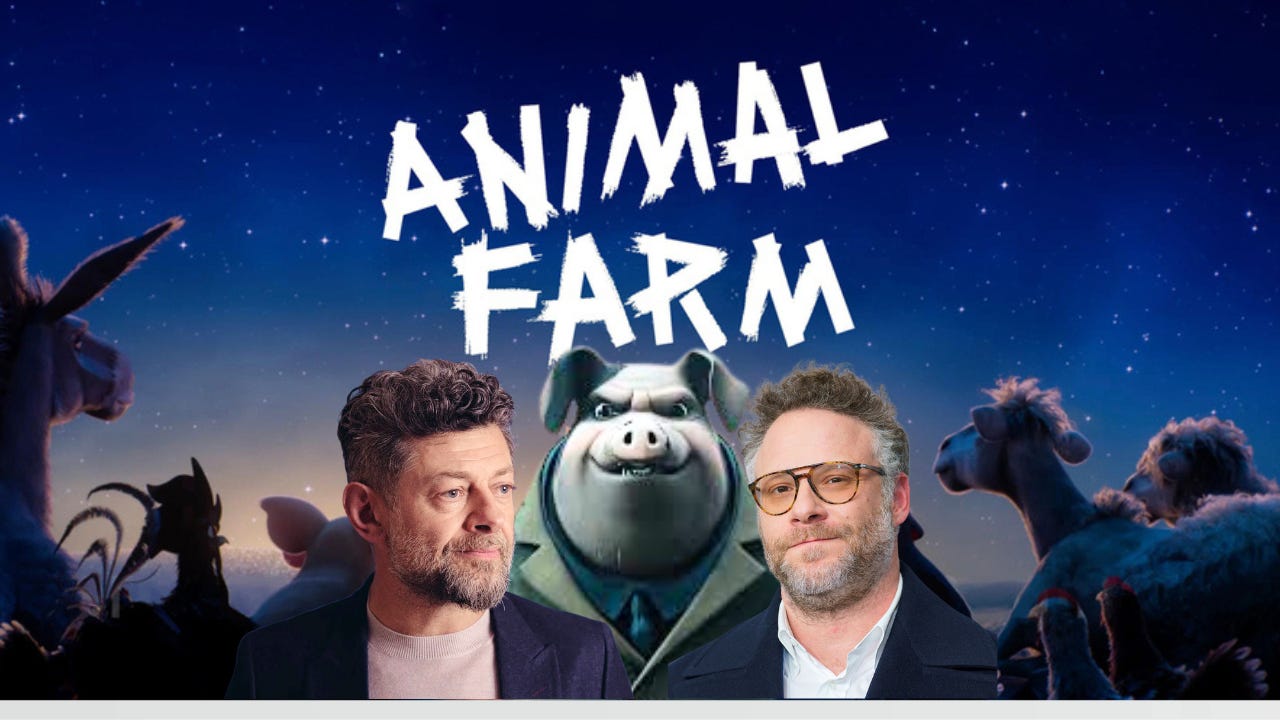
The new animated Animal Farm has bombed, having raked in just 3 million dollars on opening weekend. The cinema Score is a c-minus – the lowest ever score for an animated film. The film is a flattening of Orwell’s source material into a vague anti-capitalist morality tale that has gotten terrible reviews and pleased literally nobody.
Orwell himself was a socialist, whose experiences had persuaded him that the Soviet Union was a new form of hell and not an emerging utopia. Orwell’s novel wasn’t so much anti-Marxist, as anti-totalitarian – he had experienced imperialism, fascism and communism and disparaged them all.
Napoleon, an analogy for the sinister and vicious Stalin in the book is portrayed in this movie as loud and coarse. He farts at length as a demonstration of what “freedom” really means. In order to pay off the farmer’s mortgage, the animals host a farmers’ market to sell their produce to humans amused by the notion of an animal-run farm – so capitalism with a fairtrade and sustainability feel. Only when the pigs are tempted by the promise of wide-screen TVs, smartphones, and sports cars into colluding with a big corporation does Napoleon’s reign become fully oppressive. The film is trying to say that capitalism goes rotten when it shifts from being community-based and productive, to conspicuous consumption, which has hardly anything to do with George Orwell’s Animal Farm.
The media illiteracy around Animal farm has been pretty depressing. Right-wing influencer Riley Gaines recently posted on X that she appreciated the movie’s confirmation that “Marxism always has and always will fail,” a statement that provoked irked followers to reply that the movie is “anti-capitalist,” but really the film is saying that capitalism is easily corrupting – and if you become too swayed and addicted to it, you will end up in thrall to false idols of consumerism, which props up hierarchies who hoard and perpetuate inequality.
If you’re trying to do an allegory of capitalism, the rise of economic plutocrats, the influence of money in politics, or the crushing of independent business by monolithic and soulless chain-stores, that’s fine – but don’t have the presumption to claim that Orwell would have liked you to make it off the back of his classic work.
The film has Napoleon getting his way with the other animals with mindless consumer technology and bling, promising them that his alliance with the humans will guarantee them “free food forever” which he fails to deliver. Napoleon even joins forces with a high-tech human mogul, who drives something suspiciously similar to a Cybertruck.
If you squint really hard, you might see how this would align with George Orwell’s socialism. But that’s not what Animal Farm is for.
Orwell was dealing in generational, human stakes. Stalin’s rise and purges resulted in approximately 3.3 million official victims of repressive policies including executions, 1.5 million deaths within the gulag labour camp system as well as almost a million deaths from forced resettlement and deportations.
So, within Orwell’s fable-based text, there are dark evocations of mass human suffering, death, exploitation and oppression. That is what gives the story its profound power – and in describing the totalitarian corruption using barnyard animals, the folly of very simple impulses under the complex ideological systems and bureaucracy are revealed most plainly, and poignantly. That was Orwell’s genius.
The guys making this low-stakes, dumb rehash have very little control of allegory or irony. In a weirdly and painfully botched attempt at being meta, they took critical reviews – of which there are loads – and then tried to wittily reframe it by uploading posts of the pigs slathering contrary words over the headlines.
According to yahoo Entertainment: “This marketing stunt is a clever and playful way to demonstrate the book and the film’s themes of propaganda and misinformation. Using Napoleon for this fun marketing strategy is a fitting and funny way to pique more people’s interest in the film. It not only turns the negative reception on its head, but it also conveys the movie’s themes of censorship and information control. Bad press can be manipulated into praise, and parents can use that to teach the film’s messaging. If nothing else, it’s audacious.”
Well, it’s of course none of those things. It doesn’t work, because the reader or viewer is intended to work out the darker reality behind the pig’s commandments in Animal Farm, and the pigs in the PR narrative attempts for this film are therefore encouraging you to look just as hard at the critical reviews they’ve altered.
Strangely, this movie has been released by Angel Studios, the independent film distributor best known for Sound of Freedom, a biopic of anti–child trafficking crusader Tim Ballard and linked with the conspiracy fantasia that is QAnon. It’s also worth noting that besides Angel Studios getting in behind the work of a conspicuous atheist, religion itself doesn’t come across very well in the book. Moses the Raven represents the Russian Orthodox Church. Stalin had recruited the Russian Orthodox Church to his side - the better to cloak himself in patriotic garb.
All of this matters to me, because George Orwell is one of my heroes. It’s a minor miracle that his Animal Farm even exists - Orwell had fought on the anti-fascist side in the Spanish Civil War and been wounded. The book was written at the height of WW2 when London was under Nazi bombardment and the original manuscript of the novel was rescued by Orwell from the wreckage of his bombed-out home.
Consumer capitalism is full of exploitation, rampant speculation and rich-people creative accountancy; but Orwell, who would have detested all that, would have been more cynical and even downright scathing of something else in modernity: the priggish, doctrinaire pronouncements of progressivism. Because progressives have been the worst culprits when it comes to contorting language in service of ideology. When Orwell has the pigs declare that All animals are equal, but some animals are more equal than others, and other manipulations by Squealer, this is exactly the kind of tautologous approach progressives have used in recent years. Because their ideological constructions have been formed out of contradictions – and they’ve used language to smother those contradictions.
They argued that entertainment could have colourblind casting, with the suggestion that actors of colour could play white roles, because whiteness as a category of being was pretty simple, a kind of open-source identity; but being of colour is off limits to white people, because white people could never understand, or depict the lived experience of growing up as a person of colour, so intensely formative and shaping that it couldn’t be replicated or comprehended. But at the same time, when Macy Gray criticised the trans movement by saying that a transperson transitioning from a man to a woman couldn’t really be fully, authentically female, because being a woman meant going through and experiencing all the unique highs and lows of the formative years of being a girl, then progressives attacked her and she had to apologise because, they argued, a trans woman was authentically and completely a woman, without needing the formative and shaping experiences of girlhood and early womanhood. They also argued that gender difference doesn’t really exist, that it is mostly if not completely socially constructed. But when transgender people like Dylan Mulvaney release a music video with a hyper-girly, hyper feminine aesthetic, Mulvaney was supported as celebrating a full, unfettered femininity, meaning gender is a social construct prior to transition, but a solid, genuine naturally feminine gender post transition. The test of whether formative experience constitutes authentic identity gets applied when it produces the desired conclusion and abandoned when it doesn’t. Compelled speech – regarding pronouns and identity presentation, was pushed in a contradictory environment of empowerment and inclusivity – as long as you conformed. Mass commercial failures of entertainment co-opted as vehicles for identity politics and ideological messaging are never contextualised as rejections – the failures are always the consequence of reactionary forces review bombing, or mischaracterisation, or bigotry; and even failure is ultimately twisted to appear only as deferral: the film or show was a little too ahead of its time in its messaging, but its virtues and positions are ultimately inevitable, so failure can be framed as it being too positively daring for an audience not yet ready to embrace such progressive values.
Progressivism isn’t a unified philosophy with a central committee issuing consistent rulings. My argument is a critique of progressive discourse as a social phenomenon.
In Orwell’s 1984, Winston Smith reflects on how the Party controls history and objective truth.
“The only evidence to the contrary was the mute protest in your own bones, the instinctive feeling that the conditions you lived in were intolerable and that at some other time they must have been different.”
The “mute protest in your own bones” represents inescapable, instinctual human knowledge. It highlights the idea that true human nature is stubborn and feels “in the bones” that reality is not what is dictated or popularised.
If, one day, they made a George Orwell inspired work that took aim squarely at that thankfully receding period of doctrinaire, language-contorting progressive activist stubbornness and ostracization and compelled speech, I would watch that.
And I think George Orwell would approve.
“… and linked with the conspiracy fantasia that is QAnon.”
I don’t understand the point of this statement. Is it an attempt to link every Angel Studio production with QAnon? Seems that way to me.
Between this and "Venom: Let There Be Carnage," it appears Andy Serkis' talent for acting does not extend to directing. Given Serkis' inability to accurately translate the meaning being source material, I'm even more concerned about the misbegotten, and highly unnecessary, "LOTR: The Hunt For Gollum."