
Why Is China So Boring?

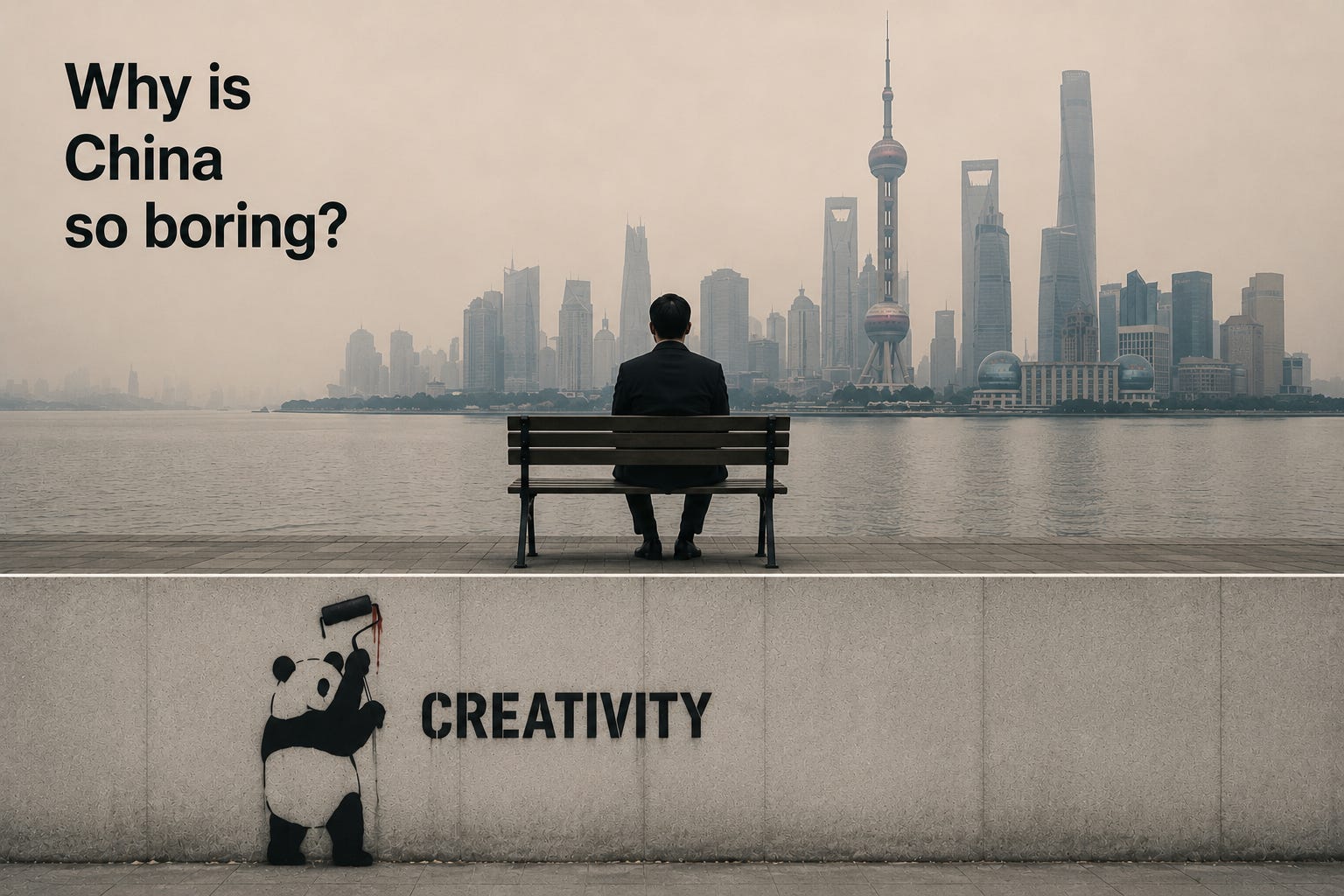
China is a massive and burgeoning country that nobody wants to imitate.
It is an industrial giant, a military superpower, and home to nearly a fifth of humanity. It manufactures much of the world’s goods, builds infrastructure at astonishing speed, dominates numerous emerging industries, and increasingly rivals the United States in strategic importance.
But ask people what cultural products, personalities, movements, aesthetics or ideas China has contributed to the global zeitgeist over the past twenty years and you’ll typically get blank silence. Then ask about Japan or Korea and the answers come instantly.
Where are the Chinese equivalents of the great Japanese auteurs, British musicians, French intellectuals, Italian designers, Scandinavian architects, or Korean pop-cultural exports? Where are the globally influential Chinese fashion houses, literary stars, rock bands, DJs, comedians, film directors, composers, magazines, game developers, or subcultures?
China has become powerful. It has not become cool.
This is not a Western prejudice; it is an empirical observation. Japan gave the world anime, manga, video game culture, avant-garde fashion, celebrated directors, and a distinctive futuristic aesthetic. South Korea transformed itself from a relatively obscure nation into a cultural superpower within little more than a decade. Even small European nations routinely produce artists, writers, filmmakers and musicians who become reference points across the world.
China, by contrast, is boring.
Pointing to language barriers doesn’t hold up: Japanese and Korean are hardly easier for outsiders to learn. Some argue that Chinese culture is thriving domestically, but simply does not travel. But great cultural movements have a habit of spreading beyond borders. If contemporary China were producing a cultural renaissance comparable to those of Japan or Korea, you would expect at least elements of it to become alluring internationally.
Another inadequate excuse is that China has been too busy becoming rich. The United States did not wait until it was fully developed before producing cultural giants. Japan’s most influential cultural exports emerged during periods of rapid economic ascent. Development and cultural creativity are not competing activities. Historically, they often reinforce one another.
China lacks prestige ecosystems and scenes. Paris had its salons. Vienna had its cafés. New York had Greenwich Village. London had Soho. Berlin had Weimar decadence and later techno culture. Such places function as magnets for ambitious, eccentric, competitive people. They create dense networks of artists, critics, publishers, patrons, rivals and hangers-on. They generate mythologies about themselves. People move there because something is happening there.
The striking thing about contemporary China is how difficult it is to identify a city, district, movement or scene that exerts any kind of gravitational pull on the world’s creative imagination. Shanghai is prosperous. Shenzhen is innovative. Beijing is powerful. None have become global bywords for cultural excitement.
Part of the reason may be political. China is a mass-surveillance police state. Genuine artistic prestige often emerges from a degree of unpredictability. The people who create lasting cultural movements are frequently troublesome. They are eccentric, obsessive, irreverent, difficult to manage and occasionally scandalous. Their work thrives on ambiguity, experimentation and provocation.
Contemporary China is hardly the ideal environment for them. Censorship does not merely suppress political criticism. What makes a culture feel exciting is rarely direct opposition to the government. It is ambiguity, irony, darkness, provocation, eccentricity, sexual experimentation, transgression, and the sense that artists are wandering into territory they are not entirely supposed to occupy. The problem is not simply that creators cannot say certain things. It is that they learn to anticipate invisible boundaries. Once enough people begin second-guessing where those boundaries lie, the culture acquires a faint but unmistakable caution. It becomes polished, accomplished, and respectable, yet strangely lacking in danger. Many of history’s most influential cultural figures were difficult precisely because they were difficult to categorise, predict, or control.
This matters because creative spheres are often downstream of broader forms of social nonconformity. The bohemian, the dissident, the sexual outsider, the obsessive crank, the flamboyant extrovert, the scandalous provocateur, the uncompromising aesthete and the political troublemaker frequently inhabit overlapping worlds. The same instinct that regards dissidence as destabilising may also regard eccentricity as undesirable, unconventional sexuality as awkward, artistic radicalism as suspicious, and public displays of individualism as faintly antisocial. A civilisation can become extraordinarily successful while minimising such tendencies. What it will struggle to produce, however, is the kind of cultural energy that the rest of the world finds compelling. Welcome to modern China.
The country has had decades to produce a globally recognised cultural vanguard. It has had the wealth, the population, the educational base and the technological sophistication. It has had enough time for scenes and even a few icons to emerge.
But the world’s second superpower is really boring.
Why create when it's easier to steal? 😉
Part of the distinction must be the embrace of communism in the 1930's (even if the revolution wasn't ultimately successful until the 1940's). Marxism (cultural Marxism, post modernism, Queer Theory) is a kind of cultural acid. By establishing itself AGAINST the things of the past (economic classes, traditions, religions, norms, age of consent laws, etc.) it promises utopia. But it doesn't attract stable or productive people. It attracts and generates resentful, emotional, utopian malcontents.
Russia was actually a rapidly modernizing and cultural quite rich country towards the end of the Romanov dynasty. It continued to modernization (at the cost of tens of millions of lives and a vast army of slave laborers) but what great cultural advances did the USSR make? These ideologies are civilizational poison. The captured countries will continue moving forward and building things and creating children and raising armies... but they're zombies. And like all zombies, they want to create more of their kind.
https://jmpolemic.substack.com/p/the-social-justice-killing-fields